
In This Article
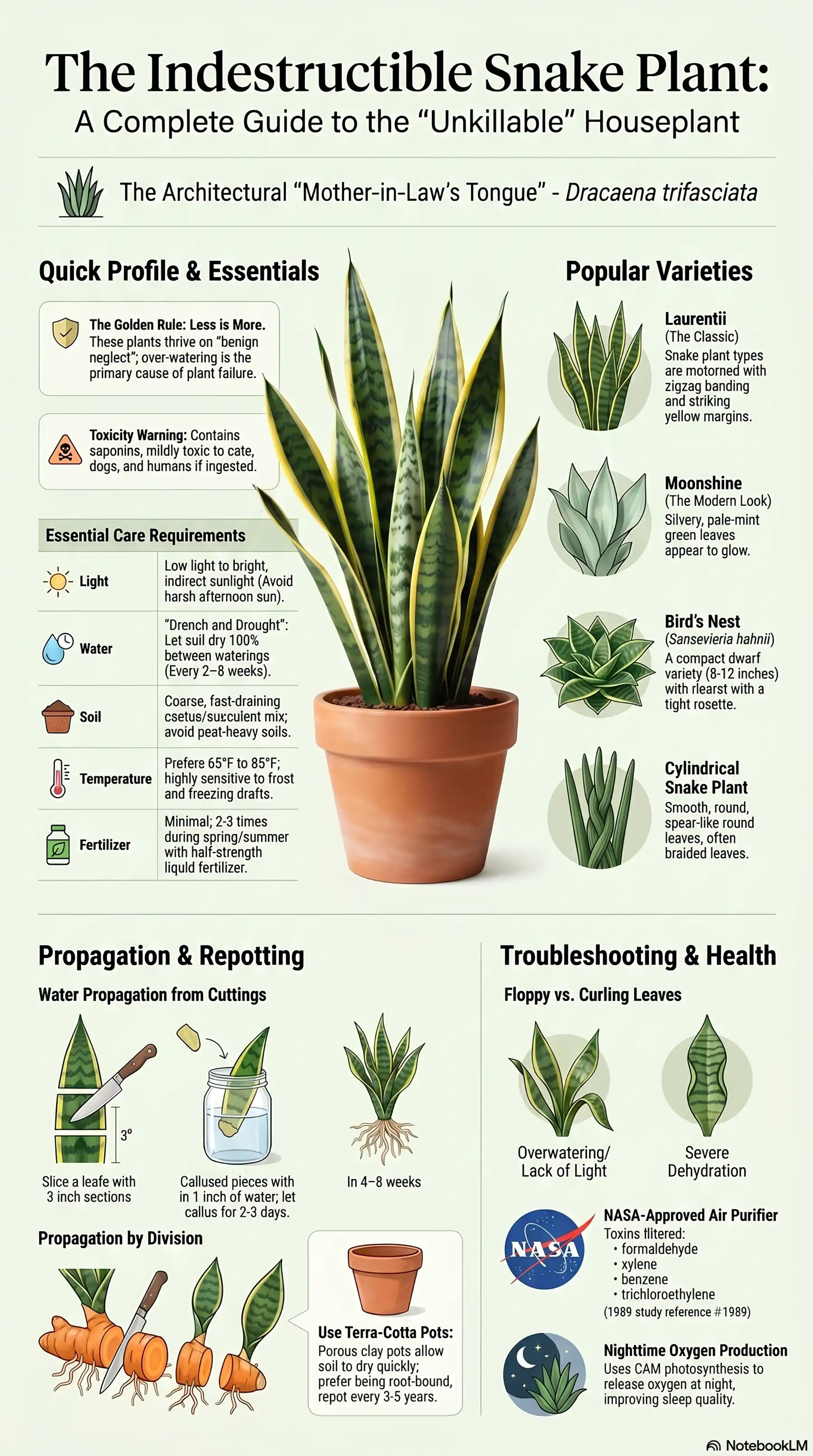
The Indestructible Houseplant: How to Grow and Care for a Snake Plant
Welcome back to Plant It! If there is a single houseplant that has earned the title of “unkillable,” it is the architectural, striking, and fiercely resilient Snake Plant.
Formerly classified entirely under the genus Sansevieria (and recently reclassified by botanists into the Dracaena genus), this tropical West African native is the ultimate plant for beginners, busy professionals, and frequent travelers. Known playfully as “Mother-in-Law’s Tongue” because of its sharp, pointed foliage, the Snake Plant provides dramatic, vertical lines that fit perfectly into modern home aesthetics.
Beyond its striking looks, it is a powerhouse of survival. It can endure droughts, low light, and dry air, all while actively filtering toxins from your indoor environment. In this comprehensive pillar guide, we will break down exactly how to care for your Snake Plant, how to multiply it, and how to troubleshoot the rare issues that might pop up.
Snake Plant Profile Quick Look
| Feature | Details |
| Common Name | Snake Plant, Mother-in-Law’s Tongue |
| Botanical Name | Dracaena trifasciata (formerly Sansevieria trifasciata) |
| Plant Type | Evergreen perennial succulent |
| Mature Size | 6 inches to 8 feet tall (depending on variety) |
| Sun Exposure | Low light to bright, indirect sunlight |
| Soil Type | Coarse, fast-draining cactus/succulent mix |
| Soil pH | Slightly acidic to slightly alkaline (5.5 to 7.5) |
| Toxicity | Mildly toxic to cats, dogs, and humans if ingested |
| Native Area | Tropical West Africa |

Essential Snake Plant Care
The golden rule of Snake Plant care is simple: less is more. These plants thrive on benign neglect. If you hover over them with a watering can every day, they will not survive.
Light Requirements
Snake plants are universally praised for their low-light tolerance. They are the go-to recommendation for windowless bathrooms, dark hallways, and shaded office cubicles. However, it is important to note that they merely tolerate the dark—they do not thrive in it.
To encourage faster growth and vibrant, highly contrasted patterns on the leaves, place your plant in bright, indirect sunlight. A spot a few feet back from an east- or west-facing window is ideal. They can even handle a few hours of direct morning sun, though blistering, direct afternoon summer rays may scorch the foliage.
Water: The Drench and Drought Method
Snake Plants are essentially succulents. Their thick, fleshy leaves and thick underground stems (rhizomes) act as water reservoirs.
You must allow the soil to dry out 100% completely between waterings. Depending on the season and your home’s lighting, this could mean watering once every two to three weeks in the summer, and only once every month or two during the winter. When you do water, drench the soil completely until water pours out of the drainage holes, and empty the saucer immediately.
Soil Needs
The best potting soil mix for sansevieria trifasciata mimics the sandy, rocky soils of its native habitat. Standard, peat-heavy potting soil retains too much moisture and will cause rapid root rot. Use a high-quality commercial cactus and succulent mix, or create your own by mixing one part standard indoor potting soil with two parts coarse sand, pumice, or perlite.
Temperature and Humidity
These African natives love the heat. Keep your indoor temperatures comfortably between 65°F and 85°F. They are highly sensitive to frost, so keep them away from freezing drafty windows or exterior doors during the winter. Standard household humidity is perfectly fine; there is absolutely no need to mist a Snake Plant.
Fertilizer
Because they grow so slowly, Snake Plants require very little feeding. Fertilize them just two or three times during the entire spring and summer growing season using a mild, balanced liquid houseplant fertilizer diluted to half strength.
Popular Types of Snake Plants
With dozens of cultivars available, you can easily build an entire collection featuring different shapes and color palettes:
- Sansevieria trifasciata ‘Laurentii’: The classic, iconic variety featuring tall, dark green leaves with zigzag banding and striking, creamy-yellow margins along the edges.
- Sansevieria cylindrica (Cylindrical Snake Plant): Features smooth, perfectly round, spear-like leaves that grow outward. Growers often braid the flexible young leaves together for a sculptural look.
- Sansevieria ‘Moonshine’: A gorgeous, modern variety boasting wide, silvery, pale-mint green leaves that appear to glow in the light.
- Sansevieria hahnii (Bird’s Nest Snake Plant): A compact, dwarf variety that maxes out at about 8 to 12 inches tall. Its leaves grow in a tight, funnel-like rosette, making it the perfect tabletop or desk plant.
Propagating Your Snake Plant
Multiplying your Snake Plant collection is easy, cost-effective, and highly rewarding. There are two primary methods:
1. Propagating Cuttings in Water
This method is incredibly fun to watch, though it requires patience.
- Using sterilized shears, cut a healthy, mature leaf from the base of the plant.
- Slice the tall leaf horizontally into 3-inch sections. Important: You must remember which direction is “up.” If you place a cutting upside down, it will not root.
- Let the cuttings rest on a paper towel for 2 to 3 days so the cut edges can form a dry callus (this prevents them from rotting in the water).
- Place the callused bottom edge of the cuttings into a jar with an inch of room-temperature water.
- Place the jar in bright, indirect light and change the water weekly. Roots will emerge in 4 to 8 weeks, followed eventually by tiny new baby plants (pups).
2. Propagation by Division
If your plant is bursting out of its pot, dividing the rhizomes is the fastest way to get a fully mature new plant. Unpot the plant and brush away the dirt to expose the thick, orange root stems (rhizomes). Use a clean, sharp knife to slice through the rhizome, ensuring each division has a healthy clump of roots and at least one leaf. Pot the divisions into dry succulent soil and wait a week before watering.
Pruning
Because the leaves grow vertically straight out of the soil, Snake Plants do not require traditional pruning to encourage branching. You only need to prune for aesthetic maintenance. If a leaf becomes permanently bent, scarred by a pet, or mushy, simply use sharp scissors to cut it off as close to the soil line as possible. The plant will naturally redirect its energy into pushing up fresh, new foliage from the root system.
Potting and Repotting
- The Right Pot: Terra-cotta or unglazed clay pots are the absolute best choice for a Snake Plant. The porous material allows the soil to dry out rapidly from the sides, adding a layer of protection against overwatering. Furthermore, Snake Plants have highly aggressive root systems that can literally shatter weak plastic or ceramic pots as they expand!
- When to Repot: They prefer to be slightly root-bound. You only need to repot every 3 to 5 years, or when the plant has become so top-heavy that it constantly tips over. Always choose a pot that is only 1 to 2 inches wider than the current one.
The Rare Phenomenon: Blooming
Most people don’t know that Snake Plants can actually flower! While it is a rare occurrence indoors, mature plants that experience mild, continuous stress (such as being severely root-bound or surviving a long drought followed by a heavy watering) may suddenly send up a tall stalk.
This stalk will be covered in clusters of delicate, greenish-white, spidery flowers. The blooms are heavily scented—often compared to sweet jasmine or vanilla—and will produce droplets of sticky, sugary nectar.
Overwintering
As the days shorten and temperatures drop in late autumn, your Snake Plant will enter a period of deep dormancy. All visible growth will halt. During this time, you must adjust your care routine. Stop fertilizing entirely, and drastically reduce your watering schedule. Depending on how warm and dry your house is, you may only need to water your Snake Plant two or three times over the entire winter season.
Common Pests
While they have an incredibly strong immune system, a weakened Snake Plant can occasionally attract common indoor pests:
- Mealybugs: Look for small, white, cotton-like masses hiding deep in the crevices where the leaves meet the soil line. Wipe them away with a cotton swab dipped in rubbing alcohol.
- Spider Mites: Microscopic arachnids that leave fine webbing and tiny yellow stippling across the tall leaves. Wipe the leaves down with a damp cloth and apply a gentle neem oil spray.
Common Problems (Troubleshooting)
Why Are My Snake Plant Leaves Falling Over?
If your normally rigid, vertical leaves are suddenly flopping over, bending, or creasing in half, you are dealing with one of two issues:
- Severe Lack of Light: Prolonged periods in deep shade will cause the leaves to grow weak, spindly, and incapable of holding their own weight.
- Overwatering: If the falling leaf feels soft, squishy, and mushy at the base, it is rotting from the inside out due to excess water.
Why Are My Leaves Curling Inward?
If the leaves are folding inward horizontally (looking deeply ribbed, puckered, or folded like a taco), the plant is severely dehydrated. Give it a deep, thorough soaking, and the leaves should plump back up over the next week.
Yellowing and Mushy Leaves
Yellowing leaves that start at the bottom and feel slimy or mushy are the universal sign of root rot. You must stop watering immediately, remove the plant from the pot, cut away the black, rotting roots, and repot it in fresh, dry soil.
Incredible Health Benefits
Beyond their striking architectural beauty, there are scientifically proven health benefits of snake plant in bedroom environments:
- NASA-Approved Air Purification: In a famous 1989 Clean Air Study, NASA identified the Snake Plant as a top performer for filtering toxic indoor airborne pollutants, including formaldehyde, xylene, benzene, and trichloroethylene (often found in carpets, paints, and cleaning supplies).
- Nighttime Oxygen Production: Most plants release oxygen during the day and carbon dioxide at night. The Snake Plant, however, uses a specialized process called Crassulacean Acid Metabolism (CAM) photosynthesis. This allows it to absorb carbon dioxide and release pure, fresh oxygen all through the night, making it the perfect plant to keep on your nightstand for better sleep quality.
- Feng Shui: In the practice of Feng Shui, the upright, sword-like leaves of the Snake Plant are believed to cut through negative energy. Placing one near an entryway is said to fiercely protect the home.