In This Article
The Queen of the Garden: How to Grow and Care for Rose Bushes
Welcome back to Plant It! If there is one plant that has universally captured the hearts of gardeners, poets, and florists for centuries, it is the spectacular rose. With their intoxicating fragrances, breathtaking arrays of colors, and elegant petal structures, rose bushes are the undisputed crown jewels of the landscape.
However, roses carry an intimidating reputation. Many beginner gardeners avoid them, believing they are overly fussy, disease-prone divas that require a master’s degree in horticulture to keep alive. We are here to bust that myth! While they do demand a bit more attention than your average evergreen shrub, modern roses are surprisingly resilient.
Whether you are dreaming of a romantic trellis draped in climbing roses or a neat row of low-maintenance shrubs lining your walkway, this comprehensive, pillar-style guide will teach you exactly how to grow, care for, and multiply your rose bushes so they reward you with decades of blooms.
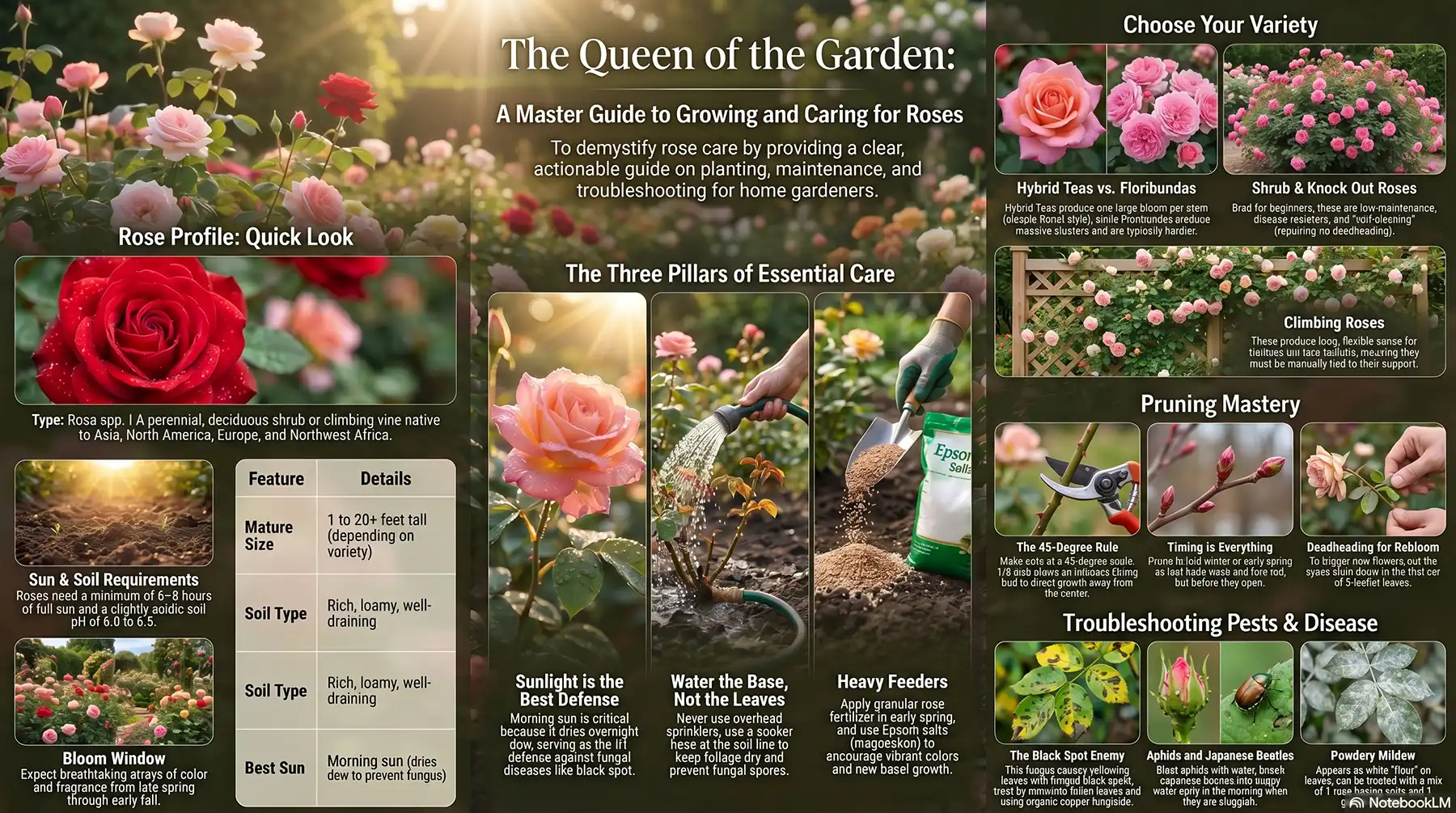
Rose Profile Quick Look
| Feature | Details |
| Common Name | Rose |
| Botanical Name | Rosa spp. |
| Plant Type | Perennial, deciduous shrub / climbing vine |
| Mature Size | 1 to 20+ feet tall (depending on the variety) |
| Sun Exposure | Full sun (6 to 8 hours minimum) |
| Soil Type | Rich, loamy, well-draining |
| Soil pH | Slightly acidic (6.0 to 6.5) |
| Bloom Time | Late spring to early fall |
| Native Area | Asia, North America, Europe, Northwest Africa |
Essential Rose Bush Care
The secret to a thriving, disease-free rose bush lies almost entirely in where and how you plant it. If you set up their environment correctly from day one, your maintenance workload drops significantly.
Light Requirements: Give Them Sun
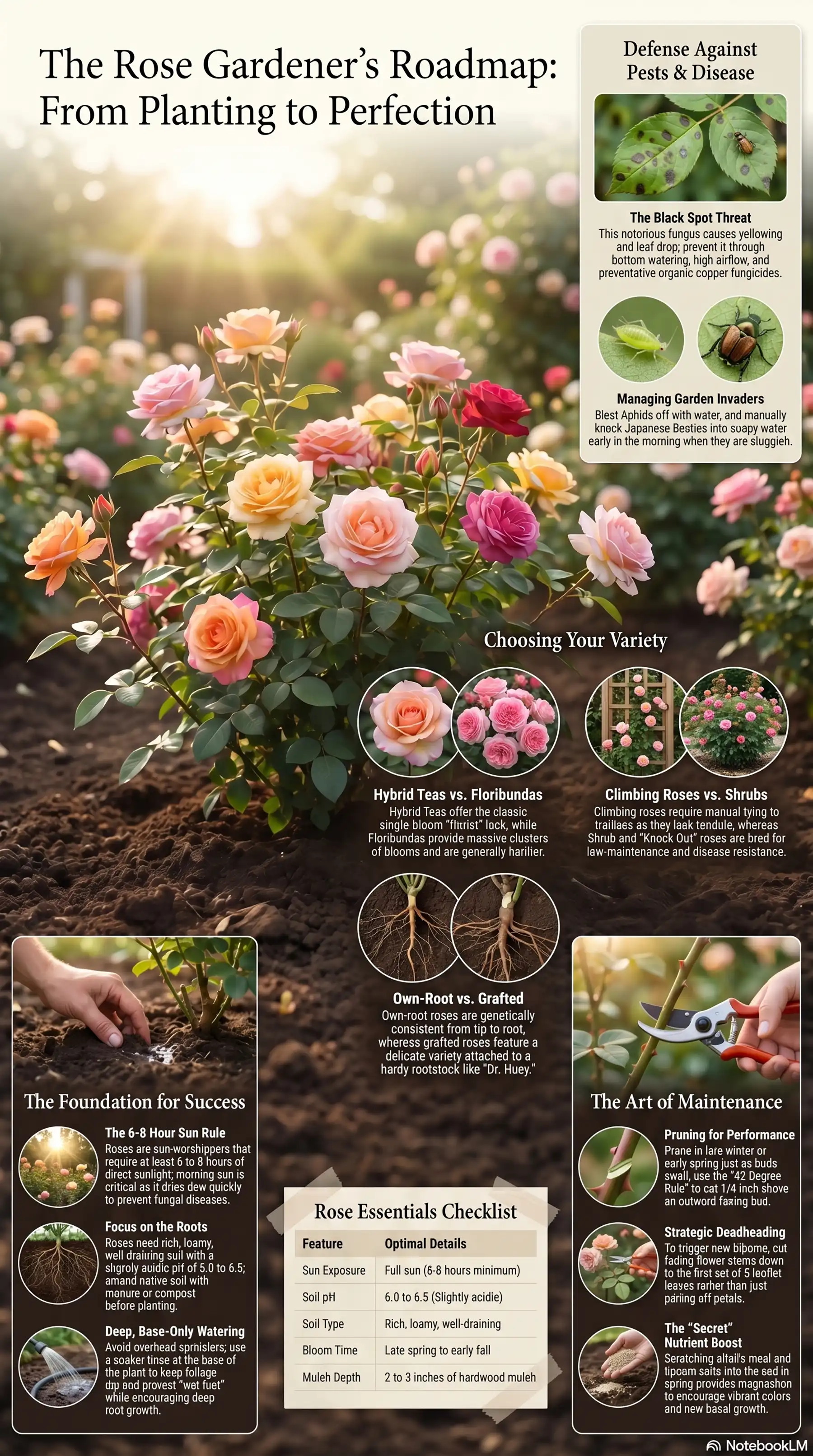
Roses are unapologetic sun-worshippers. To produce those massive, energy-intensive blooms, they require a minimum of six to eight hours of direct sunlight every single day.
Pro Tip: Morning sun is vastly more important than afternoon sun. Morning sunlight rapidly dries the overnight dew off the foliage, which is your number one defense against fungal diseases like black spot and powdery mildew. If you must choose a spot with partial shade, ensure the shade falls in the late, blistering afternoon rather than the morning.
Soil Needs
Roses are heavy feeders with deep root systems, meaning they despise poor, rocky, or compacted clay soils. They require a rich, loamy, well-draining medium. Before planting, heavily amend your native soil with organic matter such as aged manure, mushroom compost, or peat moss. This improves drainage while holding onto vital nutrients.
Water: Deep and Infrequent
Improper watering is where most gardeners go wrong. Roses hate having “wet feet” (soggy roots), but they also cannot tolerate severe droughts.
- How to water: Water deeply and slowly at the base of the plant to encourage the roots to grow deep into the earth. Avoid light, shallow sprinklings.
- Keep the leaves dry: Never use an overhead sprinkler for roses! Wet foliage is an open invitation for fungal spores to attack. Always use a soaker hose or a watering wand aimed directly at the soil line.
- Mulch: Apply a 2-to-3-inch layer of hardwood mulch around the base of the bush to lock in soil moisture and regulate ground temperature.
Fertilizer
Because they push out so many blooms, roses deplete the soil of nutrients rapidly. The best organic fertilizer for heavy blooming roses is one that is rich in phosphorus (to promote root and flower development) and nitrogen (for leafy growth).
- Apply a granular rose fertilizer in early spring as soon as new leaves emerge.
- Follow up with liquid feeds or additional granular applications every 4 to 6 weeks throughout the summer.
- Secret Garden Hack: Scratch a cup of alfalfa meal and a tablespoon of Epsom salts into the soil around the base in the spring. The magnesium in the Epsom salts encourages vibrant colors and basal cane breaks (new growth from the bottom).
Popular Types of Rose Bushes
Before you head to the nursery, it is crucial to understand that not all roses grow the same way.
- Hybrid Teas: The classic “florist rose.” They produce one large, perfectly formed, high-centered bloom at the end of a long, sturdy stem. They are beautiful but tend to be the most disease-prone and require the most pruning.
- Floribundas: The landscape show-offs. Instead of one flower per stem, they produce massive clusters of blooms. They are typically hardier and bloom continuously from spring to frost.
- Climbing Roses: These produce incredibly long, flexible canes that can be tied and trained up trellises, arbors, and pergolas. (Note: They don’t have tendrils to climb on their own; you must tie them up!)
- Shrub & Knock Out Roses: Bred specifically for low maintenance, disease resistance, and continuous blooming. They are bushy, rarely require deadheading, and are perfect for beginner gardeners.
- Miniature Roses: Tiny, perfectly scaled-down versions of standard roses, usually growing no taller than 18 to 24 inches. They are fantastic for container gardening.
Pruning Rose Bushes
Pruning terrifies many beginners, but it is actually quite difficult to kill a rose by pruning it incorrectly! Pruning removes dead, diseased wood, opens up the center of the bush for airflow, and signals the plant to push out massive new growth.
When to Prune
The best time of year to prune knockout roses, hybrid teas, and floribundas is in late winter or very early spring—just as the plant is breaking dormancy and the leaf buds begin to swell and turn red, but before they actually open.
How to Prune
- Gear up: Wear thick leather gauntlet gloves and use bypassed pruning shears that have been sterilized with rubbing alcohol.
- Clean it out: Cut away all dead, black, or shriveled wood. If a cane is brown in the center when you cut it, keep cutting lower until you reach healthy, white/green pith.
- Remove crossing canes: If two branches are rubbing against each other, remove the weaker one.
- The 45-Degree Rule: Always make your cuts at a 45-degree angle, about 1/4 inch above an outward-facing bud. This forces the new branch to grow outward, away from the center of the bush, keeping the middle open for sunlight and airflow.
Deadheading
To keep your roses blooming all summer, you must “deadhead” (remove old, fading flowers). Don’t just pull the petals off; take your shears and cut the stem down to the first set of 5-leaflet leaves. This triggers the plant to immediately start growing a new flower stem.
Propagating Rose Bushes
Want to clone your favorite heirloom rose? Propagating from cuttings is the most reliable method to get an exact genetic copy.
- Take a Cutting: In early summer, cut a 6-to-8-inch piece of a healthy stem that has just finished blooming.
- Prep the Stem: Remove the flower head and strip off all the lower leaves, leaving only the top set of leaves.
- Score and Dip: Gently scrape the bottom inch of the bark with a knife to expose the cambium layer. Dip the wet, scraped end into a high-quality rooting hormone powder.
- Plant and Cover: Plant the cutting into a pot filled with moist sand and perlite. Cover the entire pot with a clear plastic bag to create a mini greenhouse (roses lose moisture rapidly without roots).
- Wait: Place the pot in bright, indirect light. In 4 to 8 weeks, gentle resistance when you tug the cutting will indicate that roots have formed!
Growing From Seed
If you are wondering how to grow rose bushes from seed indoors, be warned: it is a project for the highly patient! Because most garden roses are complex hybrids, the seeds will not grow true to the parent plant. You are essentially rolling the genetic dice—you might create an entirely new, never-before-seen rose!
- Harvest Rose Hips: Leave a few flowers on the bush in the fall. They will swell into berry-like pods called “hips.”
- Extract the Seeds: Cut the hips open and scrape out the seeds.
- Cold Stratification: Rose seeds are dormant and think it is winter. You must simulate winter to get them to sprout. Wrap the seeds in a damp paper towel, place them in a zip-lock bag, and keep them in your refrigerator for 6 to 10 weeks.
- Sow: Once they begin to sprout in the fridge, plant them 1/4 inch deep in seed-starting trays under grow lights.
Overwintering
Roses need protection from bitter, freezing winds and the devastating freeze-thaw cycle that can heave their roots out of the ground.
- In-Ground Roses: After the first hard frost, mound about 8 to 10 inches of topsoil or compost directly over the base (the crown) of the plant. You can also cover the canes with a burlap wrap if you live in zones 5 or below. Cut incredibly tall canes back slightly so the winter winds don’t violently rock the plant and loosen the roots.
- Potted Roses: The roots of container roses are entirely exposed to freezing ambient air. Figuring out how to overwinter potted rose bushes in garage spaces is key. Wait until the plant drops its leaves and goes dormant, then simply roll the heavy pot into an unheated (but insulated) garage or shed. Water it very lightly just once a month so the roots don’t completely desiccate, and bring it back out in the spring!
Common Pests
Roses are delicious, and unfortunately, the bug kingdom agrees.
- Aphids: Tiny, pear-shaped, green or red insects that cluster in the thousands on the tender new buds and suck the sap. Blast them off daily with a strong jet of water from the hose, or release ladybugs into your garden.
- Japanese Beetles: These metallic green and copper beetles will absolutely skeletonize your rose leaves and eat the blooms from the inside out in mid-summer. The best defense is knocking them off into a bucket of soapy water early in the morning when they are sluggish. Keep beetle traps far away from your roses, as they attract more beetles to the area!
- Spider Mites: Microscopic arachnids that cause leaves to look stippled, dusty, and covered in fine webbing. They thrive in hot, dry conditions. Treat with a horticultural oil or neem oil spray.
Common Issues and Diseases
Why are my rose bush leaves turning yellow with black spots?
If you are asking this question, you are dealing with the most notorious enemy of the rose grower: Black Spot fungus (Diplocarpon rosae).
It starts as small, circular, fringed black spots on the lower leaves. As the fungus spreads, the tissue around the spots turns bright yellow, and the leaf completely drops off the plant. Left untreated, black spot will completely defoliate a rose bush by August.
- The Fix: Prevention is the only true cure. Water only at the base, ensure the bush is pruned to have an open center for maximum airflow, and spray a preventative organic copper fungicide every two weeks starting in early spring. Remove and throw away (do not compost!) any diseased fallen leaves from the soil surface to prevent spores from splashing back up.
Powdery Mildew
Looks like a dusting of white flour or talcum powder over the leaves and new buds. It causes the young leaves to crinkle and distort. It thrives in humid environments with cool nights. Treat with a sulfur-based fungicide or a homemade spray of 1 tablespoon baking soda mixed with a gallon of water and a few drops of dish soap.
FAQS
Yes, in moderation! Coffee grounds add organic matter and small amounts of nitrogen to the soil. Because they are slightly acidic, they help maintain the 6.0 to 6.5 pH that roses prefer. Sprinkle a thin layer around the base of the plant, but do not pile it on thickly, or it can repel water.
2. Can roses grow in the shade?
While a few specific varieties (like the climbing ‘Zephirine Drouhin’) can tolerate partial shade, the vast majority of roses will suffer. In the shade, they will produce long, spindly, weak canes, offer very few blooms, and become highly susceptible to fungal diseases due to a lack of evaporating sunlight.
3. What is the difference between ‘own-root’ and ‘grafted’ roses?
A grafted rose consists of the top part of a fancy, delicate rose (the scion) surgically attached to the hardy, vigorous root system of a different, wilder rose species. An “own-root” rose is grown from a cutting and is the exact same plant from the tip of the flower down to the bottom of the roots. Own-root roses are generally hardier and live much longer.
4. Why did my beautiful pink rose bush suddenly turn into a dark red one?
If you bought a grafted rose and it experienced a severe, freezing winter that killed the top part of the plant (the pink rose), the aggressive, wild rootstock underneath will survive and take over. The most common rootstock used in the US is a dark red, sprawling climbing rose called “Dr. Huey.” If your rose turns red and starts blooming only once a year, Dr. Huey has officially taken over!