In This Article
Master the Drama: How to Care for a Fiddle Leaf Fig and Keep It Thriving
Welcome back to Plant it! If you have opened an interior design magazine or scrolled through aesthetic social media feeds at any point in the last decade, you have undoubtedly seen the undisputed king of houseplant décor: the Fiddle Leaf Fig (Ficus lyrata). With its towering trunk and massive, heavily veined, violin-shaped leaves, it is a living, breathing architectural masterpiece.
However, the Fiddle Leaf Fig (often affectionately or frustratedly called an “FLF”) has a notorious reputation. It is widely considered a dramatic, finicky diva that might drop half its leaves simply because you looked at it the wrong way or moved it two inches to the left.
Fear not! While it is true that these majestic West African natives demand consistency, once you understand their specific needs, they are incredibly rewarding to grow. In this comprehensive guide, we will decode the mysteries of the Ficus lyrata so you can transform your finicky fig into a thriving indoor tree.
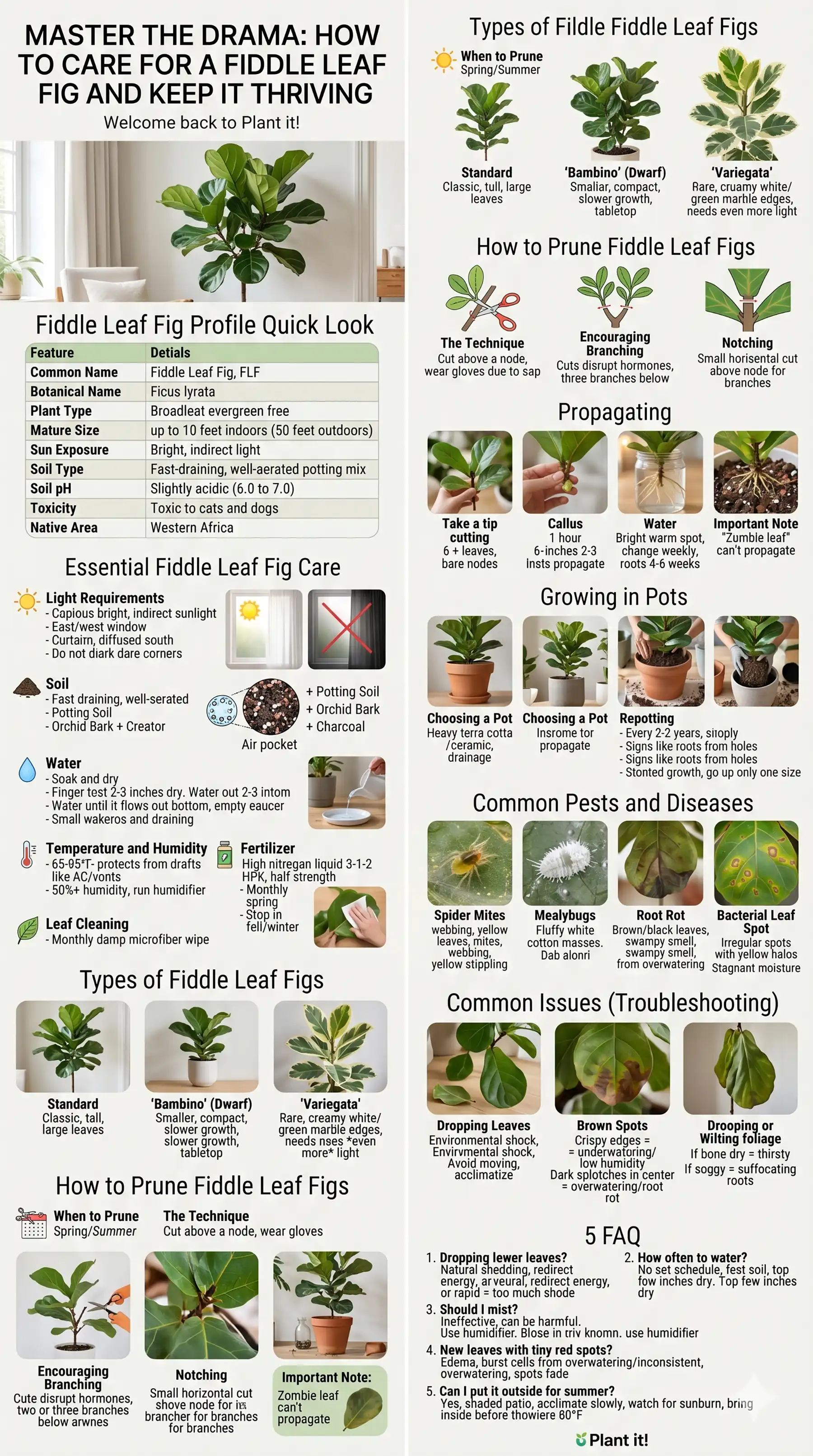
Fiddle Leaf Fig Profile Quick Look
| Feature | Details |
| Common Name | Fiddle Leaf Fig, FLF |
| Botanical Name | Ficus lyrata |
| Plant Type | Broadleaf evergreen tree |
| Mature Size | up to 10 feet indoors (50 feet outdoors) |
| Sun Exposure | Bright, indirect light |
| Soil Type | Fast-draining, well-aerated potting mix |
| Soil pH | Slightly acidic (6.0 to 7.0) |
| Toxicity | Toxic to cats and dogs if ingested |
| Native Area | Western Africa |
Essential Fiddle Leaf Fig Care
The key to learning how to care for a fiddle leaf fig indoors is mimicking its native tropical rainforest environment as closely as possible while providing strict consistency. They despise sudden changes in their environment.
Light Requirements
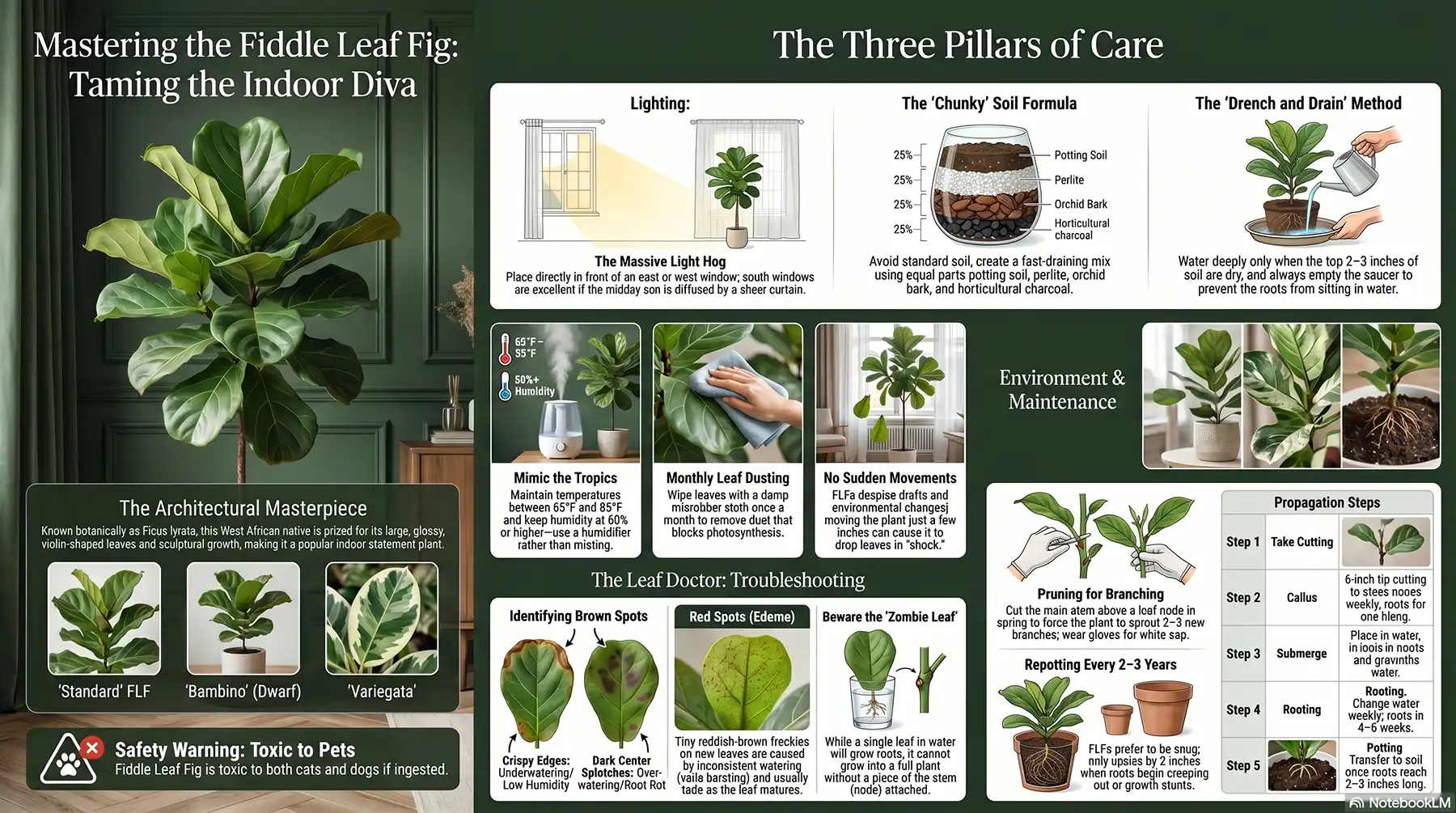
If there is one thing you must get right, it is lighting. Fiddle Leaf Figs are massive light hogs. They require copious amounts of bright, indirect sunlight to support their giant leaves. Place your tree directly in front of an unobstructed east-facing or west-facing window. A south-facing window is also excellent, provided the intense midday sun is slightly diffused by a sheer curtain to prevent scorching the foliage. If your fig is shoved into a dark corner, it will inevitably drop its leaves and slowly decline.
Soil
Because they are highly susceptible to root rot, the best soil for fiddle leaf fig in pots is one that drains rapidly while holding just enough moisture for the plant to drink. Do not use straight potting soil straight from the bag. Instead, create a chunky mix by combining standard indoor potting soil with equal parts perlite, orchid bark, and a handful of horticultural charcoal. This ensures massive air pockets around the roots, keeping them healthy and oxygenated.
Water
Improper watering is the number one killer of Fiddle Leaf Figs. They like to be soaked thoroughly and then allowed to dry out significantly.
- When to water: Stick your finger or a wooden moisture meter deep into the soil. You should only water when the top two to three inches of soil are completely dry.
- How to water: When it is time, water deeply until water pours out of the bottom drainage holes. Let it drain completely, and immediately empty the saucer. Never let your FLF sit in standing water.
Temperature and Humidity
Hailing from the tropics, these trees love it warm and humid. Keep ambient room temperatures between 65°F and 85°F. Most importantly, protect your plant from drafts. Keep it far away from blasting air conditioning vents, heating grates, and drafty winter doors. Sudden blasts of hot or cold air will send the plant into shock.
For humidity, aim for 50% or higher. If your home is dry, especially in the winter, run a continuous humidifier near your plant.
Fertilizer
Those massive leaves take a lot of energy to grow! Feed your Fiddle Leaf Fig with a high-nitrogen liquid houseplant fertilizer (look for a 3-1-2 NPK ratio) diluted to half strength once a month during the active growing season (spring and summer). Stop fertilizing entirely in the fall and winter when the plant’s growth stalls.
Leaf Cleaning
Because the leaves are so broad, they collect household dust rapidly. A thick layer of dust physically blocks sunlight, preventing photosynthesis and stifling the plant’s growth. Once a month, take a damp, soft microfiber cloth and gently wipe down the top and bottom of every single leaf.
Types of Fiddle Leaf Figs
While the classic Ficus lyrata is the most common, there are a few distinct cultivars you might encounter at the nursery:
- Ficus lyrata (Standard): The classic, fast-growing indoor tree that can reach up to 10 feet tall with leaves up to 15 inches long.
- Ficus lyrata ‘Bambino’ (Dwarf): Perfect for small spaces, the ‘Bambino’ has much smaller, slightly thicker, and more compact leaves. It grows slower and typically maxes out at around 3 feet tall, making it a great tabletop plant.
- Ficus lyrata ‘Variegata’: An exceedingly rare and highly coveted variety featuring beautiful creamy white and light green marbling along the edges of the leaves. It requires even more light than the standard version to maintain its variegation.
How to Prune Fiddle Leaf Figs
Figuring out how to prune a leggy fiddle leaf fig is essential for maintaining its shape and encouraging it to branch out like a true tree rather than growing as a single, tall stick.
- When to Prune: Spring or early summer, when the plant has plenty of energy to heal and push out new growth.
- The Technique: Using sharp, sterilized pruning shears, cut the main stem just above a leaf node. Do not be alarmed by the sticky, white latex sap that bleeds from the cut (this sap can irritate skin, so wear gloves!).
- Encouraging Branching: When you chop the top off an FLF, it disrupts the plant’s growth hormones, usually forcing it to push out two or three new branches from the nodes just below the cut.
- Notching: If you don’t want to lose height but want branches, you can try “notching.” Use a sterile knife to make a small, horizontal cut (about 1/4 of the way through the trunk) just above a leaf node. This can trick the plant into sprouting a branch at that specific spot.
Propagating
If you have pruned your tree, don’t throw away the cuttings! Learning how to propagate fiddle leaf fig in water is a fun way to multiply your plant collection.
- Take a tip cutting that is at least 6 inches long and includes 2 to 3 healthy leaves and a few bare nodes at the bottom.
- Allow the cut end to callus over for an hour.
- Place the stem in a tall glass of room-temperature water, ensuring the bare nodes are submerged but the leaves remain completely dry.
- Place the glass in a bright, warm spot out of direct sunlight and change the water weekly to prevent bacterial buildup.
- In 4 to 6 weeks, you should see white roots sprouting. Once the roots are 2 to 3 inches long, plant the cutting in a chunky potting mix.
Important Note: You cannot propagate a Fiddle Leaf Fig from a single leaf without a piece of the stem attached. A single leaf placed in water will grow roots, but it lacks the stem tissue (node) required to ever grow a new plant. It will simply remain a “zombie leaf” until it eventually dies.
Growing in Pots
Keeping a tree in a pot requires careful attention to the root zone.
- Choosing a Pot: Always choose a heavy pot (like terra-cotta or thick ceramic) with drainage holes. Fiddle Leaf Figs become top-heavy as they grow, and lightweight plastic pots will easily tip over.
- Repotting: These plants like to be somewhat snug in their pots. You will only need to repot every two to three years. Signs it is time to upsize include roots creeping out of the bottom drainage holes, water running straight through the soil instantly, or stunted growth. When repotting, only go up one pot size (about 2 inches wider in diameter).
Common Pests and Diseases
Even indoor trees face pests. Inspect your plant regularly when you wipe down the leaves.
- Spider Mites: These microscopic pests thrive in dry, warm homes. They suck the sap from the leaves, leaving tiny yellow stippling and fine, dusty webbing where the leaf meets the stem. Treat by showering the plant and applying insecticidal soap or neem oil.
- Mealybugs: Look like fluffy, white cotton masses hiding in the crevices of the plant. Dab them away with a cotton swab dipped in rubbing alcohol.
- Root Rot: A fatal fungal disease caused by overwatering and poor drainage. The leaves will turn dark brown or black and fall off, and the soil will smell like swampy rot.
- Bacterial Leaf Spot: Presents as irregular brown spots with distinct yellow halos around them. It thrives in stagnant, overly moist environments. Remove severely affected leaves and avoid getting water on the foliage.
Common Issues
Why is My Fiddle Leaf Fig Dropping Leaves?
If your FLF is rapidly dropping green or slightly yellowing leaves, it is experiencing environmental shock. Did you recently bring it home? Move it to a new room? Repot it? Fiddle Leaf Figs hate change. Find the brightest spot in your house, put it there, and do not move it again. It will eventually acclimatize and recover.
Brown Spots on Leaves
- Crispy, light brown edges: Usually a sign of underwatering or severe lack of humidity.
- Dark brown/black splotches in the center of the leaf: This is almost always a symptom of overwatering and impending root rot. Let the soil dry out immediately!
Drooping or Wilting Foliage
If the leaves are hanging limply and the soil is bone dry, it is simply thirsty and will perk right back up after a thorough watering. If the leaves are drooping but the soil is soggy, the roots are suffocating and cannot uptake water.